Problems due to Static Electricity and ESD Damage
As explained in "Strength (Voltage) of Electric Shocks Caused by Static Electricity and Environments where Electrification Easily Occurs" above, even the static electricity felt when a person touches a metal doorknob can generate voltage of 3.0 kV or more. Furthermore, in a low-humidity environment, merely walking on a carpet can electrify a person with a voltage as high as 35.0 kV. Such static electricity risks causing problems in various contexts in daily life, as well as on manufacturing sites. Here, we will introduce examples of problems due to static electricity, the causes of damage due to electrostatic discharge (ESD), and methods for preventing such problems.
Examples of Problems due to Static Electricity
Like magnets, substances electrified positively (+) and substances electrified negatively (-) exert an attractive force on each other, and substances electrified with the same polarity exert a repulsive force on each other. These forces are called Coulomb forces.
Static electricity can also lead to malfunction or damage to delicate electronic components such as ICs. Examples of problems caused by this characteristic of static electricity are provided below.
Adhesion due to static electricity
In the processing of items such as films, or before painting a frame or casing, foreign matter (dust) in the air may adhere to the item, items being processed may stick to each other, or automatic parts feeders may become clogged, which can lead to defects or decreased yield.
Misalignment or ejection due to static electricity
Misalignment of tiny parts can result in assembly defects, and capsules may be ejected from plastic containers in packaging processes for products such as medicines, thereby leading to defects.
IC damage or malfunction, etc. in electronic devices due to electrostatic discharge (ESD)
In electronic device assembly processes, electrostatic discharge (ESD) may be applied to circuit boards and damage the ICs. In addition, if ESD is generated from a user's body when they press a button on an electrical product or insert and remove plugs to and from various interfaces such as USB, the ICs and other semiconductor components inside the device may be damaged.
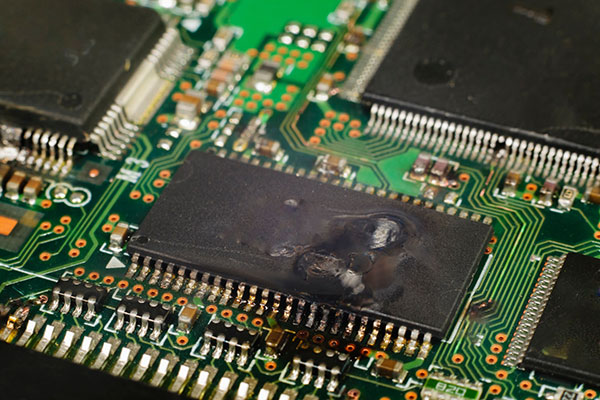 IC inside a PC burned due to electrostatic discharge (ESD)
In addition to damage caused by factors such as IC burning due to ESD intrusion, as shown in the photo above, there are also cases where electromagnetic noise generated during electrostatic discharge causes electronic devices to malfunction, or where static electricity leads to ignition, explosion, or fire, etc.
Causes of damage due to electrostatic discharge (ESD damage)
ESD is an abbreviation of "electrostatic discharge" and refers to the phenomenon in which, when static electricity discharges, high voltage and large current are applied to the semiconductor devices in IC circuits, causing malfunction or damage and leading to device failure.
Electrostatic discharges that result in ESD damage are mainly classified into the following three models.
Human Body Model (HBM)
When an electrically charged person's hand touches a conductive part of a circuit board or a semiconductor device, a sudden discharge current occurs and is applied to semiconductor devices such as ICs, causing ESD damage. In addition, discharge from the human body to internal circuits can also occur via the buttons or interfaces of electrical devices.
Charged Device Model (CDM)
When a semiconductor device or similar component is in an electrified state due to friction, etc., and a conductive part is grounded*3, a sudden discharge current flows and ESD damage occurs.
Machine Model (MM)
This is a model in which a rapid discharge current occurs when an electrically charged conductor comes into contact with a semiconductor device, leading to ESD damage. For example, when the device side is grounded*3, discharge occurs if the conductive part of an electrically charged device comes into contact with it. This phenomenon also requires attention in the design of factory automation equipment.
- *3Grounding is also called earthing and refers to a connection or equipment that shunts current to the ground. By connecting a conductor and the ground with an earthing wire, static electricity occurring on the conductor is quickly discharged to the ground. In general, electrical appliances such as washing machines, refrigerators, and microwave ovens have earthing wires, and electrical outlets are also equipped with ground terminals where such appliances are installed.
How to Prevent Problems due to Static Electricity
Here, we will describe some measures to combat static electricity problems, with a focus on environmental or object electrification and ESD damage.
Measures to combat static electricity problems (such as electrostatic adhesion and ESD damage) in factories
Measures to combat static electricity problems based on the above-mentioned Human Body Model generally consist of workers wearing wrist straps grounded with earthing wires to prevent electrification and the use of anti-static mats. This enables prevention of the occurrence of ESD damage.
In addition, a method for preventing ESD damage based on the Charged Device Model or the Machine Model is the use of ionizers (static eliminators) that neutralize accumulated electric charges. By also controlling the humidity, the risk of electrification can be further reduced, leading to the prevention of static electricity problems.
Measures against static electricity problems (ESD damage) in products
When static electricity is discharged from various input/output interfaces such as power ports and USB, operation buttons, and other points that people touch, that overvoltage can be applied to internal IC circuits, leading to malfunction or damage. This means that there is a risk of ESD damage based on the Human Body Model, even in usage environments such as ordinary households and offices.
A typical countermeasure method is the use of "ESD protection elements" that suppress and divert excessive voltage inflow due to ESD, thereby protecting semiconductor devices such as ICs from the application of overvoltage. By installing ESD protection elements on signal lines leading from various interfaces and operation buttons to ICs, ICs are protected from high-voltage pulses caused by ESD.
"What are ESD Protection Elements? Types of ESD Protection Devices and How They Work" provides a detailed explanation of basic knowledge, types, and advantages of ESD protection elements.